Descripción
Calcular \( \displaystyle \int \sqrt{16-x^2}\,d\,x\).
Referencias: Example 1. Section 108 from James Michie. Page 191.
Solución.
El integrando tiene la forma , se hace la sustitución:
| x = 4 sen θ | ||
| \(\displaystyle\sqrt{16 – x^2}= \sqrt{16 – 16 \sin^2 \theta} \) | ||
| \(\displaystyle\sqrt{16 – x^2}= \sqrt{16\,(1 – \sin^2 \theta)} \) | ||
| \(\displaystyle\sqrt{16 – x^2}= \sqrt{16\,\cos^2 \theta} \) | ||
| \(\displaystyle\sqrt{16 – x^2}= 4 \cos \theta \) |
Al sustituir \( \displaystyle \sqrt{16 – x^2} = 4\cos \theta\) y d x = 4 cos θ d θ en la integral:
\( \displaystyle \int\sqrt{16-x^2}\,d\,x=\int(4\cos\theta)\,(4\cos\theta\,d\,\theta)\)
\( \displaystyle \int\sqrt{16-x^2}\,d\,x=\int 16\cos^2\theta\,d\,\theta\)
\( \displaystyle \int\sqrt{16-x^2}\,d\,x=16\int \cos^2\theta\,d\,\theta\)
La integral anterior se resuelve aplicando integración de potencias de funciones trigonométricas.
\( \displaystyle \int\sqrt{16-x^2}\,d\,x=16\int \frac{1}{2}(1+\cos 2\,\theta)\,d\,\theta\)
\( \displaystyle \int\sqrt{16-x^2}\,d\,x=8\int (1+\cos 2\,\theta)\,d\,\theta\)
\( \displaystyle \int\sqrt{16-x^2}\,d\,x=8\int d\,\theta+8\int \cos 2\,\theta\,d\,\theta\)
La integración conduce a:
\( \displaystyle \int\sqrt{16-x^2}\,d\,x=8\,\theta+8\,\left(\frac{1}{2}\sin 2\,\theta\right)+C\)
\( \displaystyle \int\sqrt{16-x^2}\,d\,x=8\,\theta+4\,\sin 2\,\theta+C\)
Para volver a la variable inicial, no es posible definir en forma directa sen 2 θ en función de x, por lo cual se aplica la identidad sen 2 θ = 2 sen θ cos θ
\( \displaystyle \int\sqrt{16-x^2}\,d\,x=8\,\theta+4\,(2\,\sin\theta\,\cos\theta)+C\)
\( \displaystyle \int\sqrt{16-x^2}\,d\,x=8\,\theta+8\sin \theta\,\cos\theta+C\) (1)
Para volver a la variable original se debe definir θ, sen θ y cos θ en función de x.
Partiendo de la sustitución trigonométrica realizada:
x = 4 sen θ
\( \displaystyle \sin\theta=\frac{x}{4}=\frac{\text{Cateto opuesto}}{\text{Hipotenusa}}\)
Se construye un triángulo rectángulo cuyo cateto opuesto es x e hipotenusa es 4. El lado faltante, se determina con la aplicación del teorema de Pitágoras.
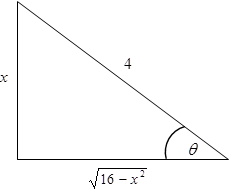
Observe que la magnitud del lado faltante \( \displaystyle\sqrt{16-x^2}\) coincide con la expresión que se encuentra en el integrando.
A partir del triángulo obtenido, se define θ, sen θ y cos θ.
\( \displaystyle \theta=\sin^{-1}\left(\frac{x}{4}\right)\) (2)
\( \displaystyle \sin\theta=\frac{\text{Cateto opuesto}}{\text{Hipotenusa}}\)
\( \displaystyle \sin\theta=\frac{x}{4}\) (3)
\( \displaystyle \cos\theta=\frac{\text{Cateto adyacente}}{\text{Hipotenusa}}\)
\( \displaystyle \cos\theta=\frac{\sqrt{16-x^2}}{4}\) (4)
Al sustituir las ecuaciones (2), (3) y (4) en la ecuación (1):
\( \displaystyle\int\sqrt{16-x^2}\,d\,x=8\left[\sin^{-1}\left(\frac{x}{a}\right)\right]+8\left(\frac{x}{4}\right)\,\left(\frac{\sqrt{16-x^2}}{4}\right)+C\)
\( \displaystyle \int \sqrt{16-x^2}\,d\,x=8\sin^{-1}\left(\frac{x}{4}\right)+\frac{1}{2}x\sqrt{16-x^2}+C\).