Descripción
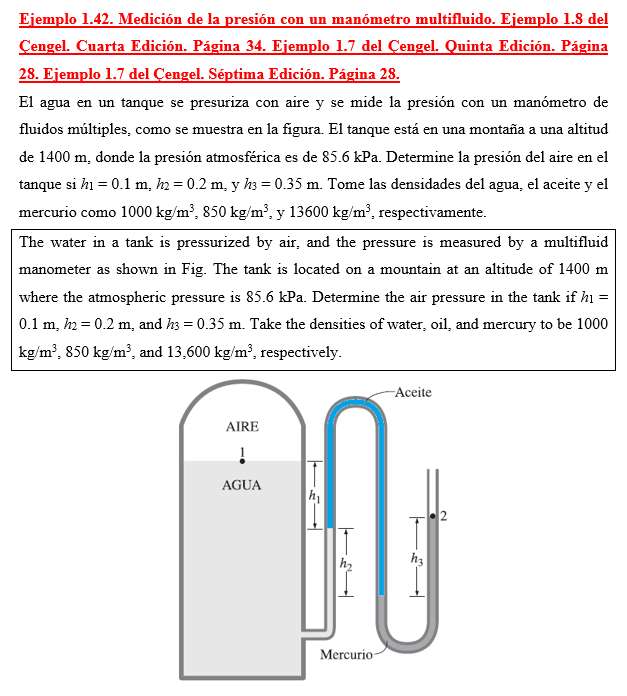
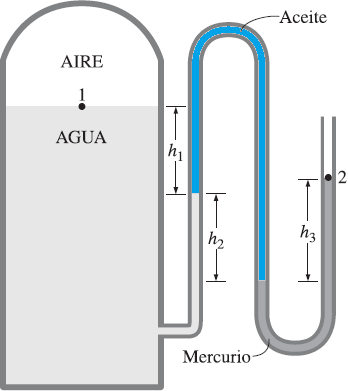
El agua en un tanque se presuriza con aire y se mide la presión con un manómetro de fluidos múltiples, como se muestra en la figura. El tanque está en una montaña a una altitud de 1400 m, donde la presión atmosférica es de 85.6 kPa. Determine la presión del aire en el tanque si h1 = 0.1 m, h2 = 0.2 m, y h3 = 0.35 m. Tome las densidades del agua, el aceite y el mercurio como 1000 kg/m3, 850 kg/m3, y 13600 kg/m3, respectivamente.
*****
The water in a tank is pressurized by air, and the pressure is measured by a multifluid manometer as shown in Fig. The tank is located on a mountain at an altitude of 1400 m where the atmospheric pressure is 85.6 kPa. Determine the air pressure in the tank if h1 = 0.1 m, h2 = 0.2 m, and h3 = 0.35 m. Take the densities of water, oil, and mercury to be 1000 kg/m3, 850 kg/m3, and 13600 kg/m3, respectively.
*****
Referencias:
Ejemplo 1.8 del Çengel. Cuarta Edición. Página 34.
Ejemplo 1-7 del Çengel. Quinta Edición. Página 28.
Ejemplo 1-7 del Çengel. Séptima Edición. Página 28.
Solución.
Se identifican los puntos de interfase entre los fluidos manométricos y los puntos de igual altura para un fluido manométrico en particular.
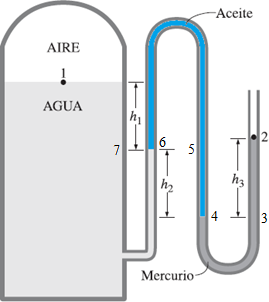
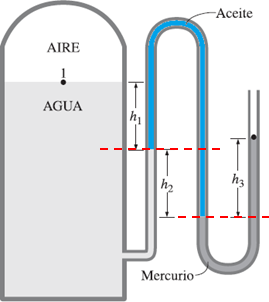
Se observa en la figura que P7 = P6 = P5 y adicionalmente P4 = P3. (Las líneas punteadas rojas representan puntos de igual presión).
A partir de la figura, tenemos:
P2 = Patm
P3 = P2 + ρHg g h3
P4 = P3
P5 = P4 – ρAceite g h2
P6 = P5
P7 = P6
P1 = P7 – ρAgua g h1
Al sumar las ecuaciones anteriores:
P2 + P3 + P4 + P5 + P6 + P7 + P1 = Patm + P2 + ρHg g h3 + P3 + P4 – ρAceite g h2 + P5 + P6 + P7 – ρAgua g h1
Al simplificar P2, P3, P4, P5, P6 y P7:
P1 = Patm + ρHg g h3 – ρAceite g h2 – ρAgua g h1
P1 = Patm + g (ρHg h3 – ρAceite h2 – ρAgua h1)
Al sustituir valores
P1 = 85.6 kPa + 9.81 m/s2 (13600 kg/m3 × 0.35 m – 850 kg/m3 × 0.2 m – 1000 kg/m3 × 0.1 m)
P1 = 85.6 kPa + 9.81 m/s2 (4760 kg/m2 – 170 kg/m2 – 100 kg/m2)
P1 = 85.6 kPa + 9.81 m/s2×4490 kg/m3
P1 = 85.6 kPa + 44046.9 Pa
P1 = 85.6 kPa + 44.05 kPa
P1 = 129.65 kPa